
Importing Coffee & Tea from Albania into the United States in 2026 carries a total effective tariff of 0.0%. That figure is the stacked rate applied to the customs value before fees. Use the calculator below for the exact landed cost, including Merchandise Processing and Harbor Maintenance fees.
Calculate Your Landed Cost
Adjust values for Coffee & Tea from Albania
How Tariffs Stack
Each layer adds to the total cost — amounts based on customs value
Full Landed Cost Breakdown
Based on a $10,000 ocean shipment (FOB value)
How the Tariff Rate is Calculated
The tariff structure for coffee & tea follows the US stacking formula: the MFN base rate of 0%. The special tariff layer (the highest of Section 122, Section 232, or bilateral rates) is 0%, which combines with the MFN base to produce a subtotal before Section 301 duties. Adding all layers yields a total tariff rate of 0%. On a customs value of $10,600.00, this translates to total duties of $0.00, plus the Merchandise Processing Fee of $36.72 and Harbor Maintenance Fee of $13.25. The total landed cost including all fees reaches $10,649.97.
Trade Context
The United States imported $300M in goods from Albania in 2024, making it a significant trading partner in the Europe region. Key import categories from Albania include clothing garments, footwear, industrial machinery, reflecting the country's industrial and agricultural strengths. Coffee & Tea represents an important segment of this trade relationship, with demand driven by both price competitiveness and product availability in the US market. The bilateral trade volume underscores the economic significance of tariff policy decisions affecting imports from Albania.
What Section 122's Lapse Means for This Import
Section 122 lapsed on July 24, 2026, but this product category was already exempt from the Section 122 surcharge, so the lapse changed nothing. The exemption applies to product categories deemed essential or strategically important. Importers of coffee & tea from Albania saw no change in tariff costs from the Section 122 lapse.
Alternative Sourcing Countries for Coffee & Tea
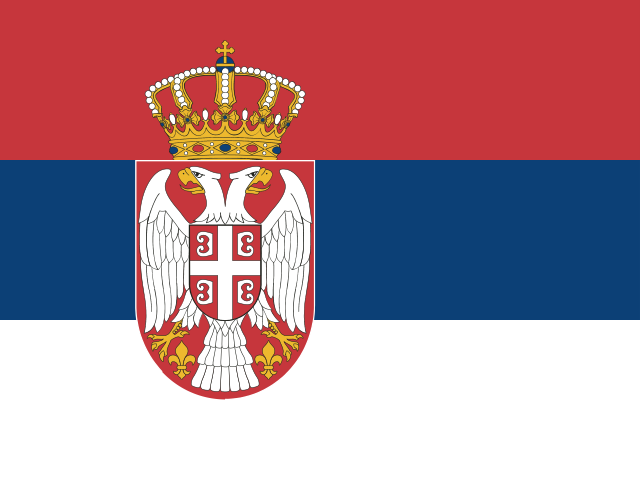
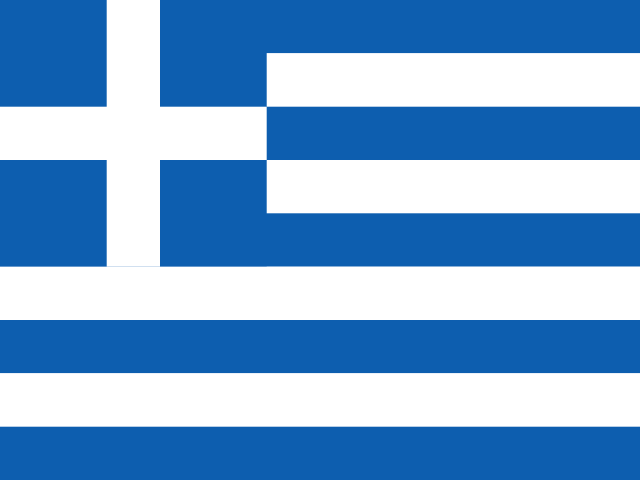
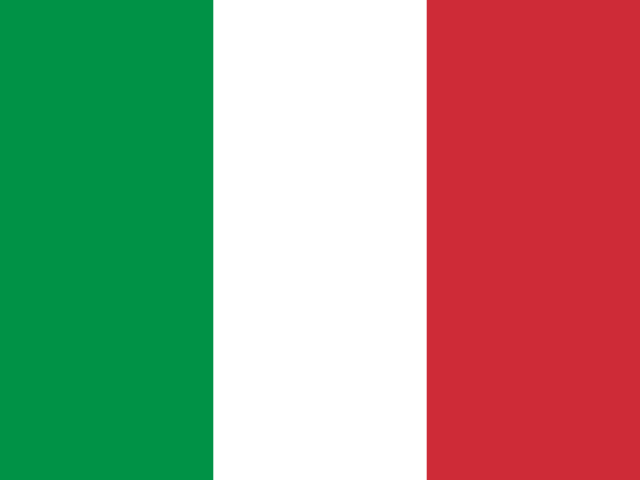
Importers looking for lower tariff costs on coffee & tea may consider sourcing from Serbia (effective rate 0%); North Macedonia (effective rate 0%); Greece (effective rate 10%). Compared to Albania's total effective rate of 0%, these alternatives offer potential cost savings depending on the specific product classification and applicable trade agreements. Each alternative carries its own tariff structure, so importers should calculate the full landed cost before switching suppliers.

Tariff Timeline for Albania
The Section 232 action on pharmaceuticals and pharmaceutical ingredients took effect for the companies listed in Annex III to Proclamation 11020, with all remaining companies following on September 29, 2026. The duty is 100 percent ad valorem on patented pharmaceuticals and associated pharmaceutical ingredients, reduced to 20 percent for companies with onshoring plans approved by the Secretary (rising to 100 percent on April 2, 2030), 15 percent for Japan, the European Union, the Republic of Korea, and Switzerland and Liechtenstein jointly, and 10 percent for the United Kingdom. Generic pharmaceuticals and their associated ingredients, including biosimilar products, are expressly excluded.
The Section 301 forced-labor import duties were challenged at the U.S. Court of International Trade. The duties remain in effect pending the court's review; no injunction or stay has been issued.
Section 122 uniform 10% global surcharge lapsed to 0% by operation of law after its 150-day statutory limit (19 U.S.C. §2132). No Congressional extension was enacted (S.4049 is a repeal, not an extension); the CAFC appeal remains unresolved.
Proclamation 11045 established a Section 232 onshoring incentive for primary aluminum. It imposes no duty and changes no rate — the word 'percent' does not appear in its operative text. A company whose onshoring plan the Secretary approves may annually import a quantity of primary aluminum matching its planned U.S. facility's reasonably anticipated annual output at half the Section 232 rate otherwise in effect. Plans must commit to starting construction by January 20, 2029, refurbishment adjustments are capped at the value of the investment, and benefits may be rescinded — retroactively where fraud is found. Any HTSUS changes are left to a future Federal Register notice from the Secretary. The benefit is company-specific, quantity-limited and conditional, so 50 percent remains the correct rate for an ordinary importer.
The Section 232 investigation into commercial aircraft, jet engines, and aircraft/engine parts concluded that imports threaten to impair national security, but the President imposed NO tariff. The proclamation instead directs a 180-day negotiation window (through approximately January 5, 2027), continued monitoring, and reserves the possibility of alternative remedies in the future.
Proclamation 11032 adjusted the aluminum, steel and copper regimes without changing the 50 percent full-value rate. It expanded the temporarily-reduced 15 percent derivative tier to agricultural equipment and certain predominantly-residential HVAC systems and components; lowered the threshold for qualifying as made 'entirely' from American aluminum, steel or copper from 95 percent to 85 percent; and provided that for products of Canada and Mexico qualifying for USMCA preferential treatment, a 25 percent duty applies only to the non-U.S. content of the product.
Proclamation 11021 consolidated the aluminum, steel and copper Section 232 regimes into a single instrument and restated the full-value rate at 50 percent ad valorem — the headline rate did not move. Articles listed in its Annex I-A are dutiable at 50 percent unless a lower rate applies: 25 percent for United Kingdom products whose aluminum content was smelted or most recently cast in the UK (steel: melted and poured in the UK), and 10 percent for derivative articles whose aluminum content was smelted and cast in the United States. Derivative articles are separately set at 25 percent, with a temporarily-reduced 15 percent tier for fixed industrial machinery and power equipment. Russian-origin primary aluminum remains subject to the 200 percent rate from Proclamation 10522.
Section 122 enacted at 10% as uniform global surcharge on all imports (announced rate was 15%). Enacted under Trade Act of 1974 Section 122 authority following balance-of-payments concerns. Expires 150 days from enactment (~July 24, 2026). De minimis $800 exemption simultaneously suspended for all countries.
Section 232 duties took effect on medium- and heavy-duty trucks, their parts, and buses. Medium/heavy trucks and covered parts (core HTS 8704) carry 25%; buses (HTS 8702) carry a separate 10% tier. The duties are additive on existing MFN duties; light-duty pickups (HTS 8704.21) are excluded from the truck action.
Section 232 duties on timber, lumber, and derivative wood products took effect. Softwood timber and lumber (HTS Chapter 44) carry a flat 10%; upholstered wooden furniture (HTSUS 9903.76.02) and kitchen cabinets/vanities (HTSUS 9903.76.03) entered coverage at 25%. The self-executing escalation to 30% (furniture) and 50% (cabinets) originally scheduled for January 1, 2026 was delayed one year by Presidential Proclamation 11000; the operative furniture and cabinet tier today is 25%, with the 30%/50% escalation now scheduled for January 1, 2027.
Showing 10 of 16 events
Frequently Asked Questions
The current total tariff rate on Coffee & Tea from Albania is 0%. This is composed of the following layers: MFN base rate: 0%. The effective tariff rate after all layers is 0%.
For a $10,000 shipment of Coffee & Tea from Albania, you can expect to pay approximately $0.00 in total duties at the current rate of 0%. Additional fees include the Merchandise Processing Fee (MPF) and, for ocean shipments, the Harbor Maintenance Fee (HMF). The total landed cost for a $10,000 order would be approximately $10,000.00, representing an effective cost increase of 0% over the FOB price. Use our tariff calculator for precise calculations based on your specific shipment value and shipping method.
No, Coffee & Tea is exempt from the Section 122 surcharge. This product category has been granted an exemption from Section 122 duties, meaning the surcharge does not add to the tariff cost for coffee & tea from Albania or any other country.
Section 122 lapsed on July 24, 2026 after its 150-day statutory limit, and Albania is not among the roughly 60 economies covered by the forced-labor Section 301 duty that took effect the same day. The Section 122 surcharge that previously applied to Coffee & Tea was removed, leaving the total tariff rate at 0% based on the remaining tariff layers. No replacement surcharge backfilled the lapse for Albania.
For Coffee & Tea, alternative sourcing countries to consider instead of Albania include Serbia (effective rate: 0%), North Macedonia (effective rate: 0%), Greece (effective rate: 10%). Compared to Albania's total effective rate of 0%, these alternatives may offer lower landed costs depending on the specific HTS classification. Use our country comparison tool to see a detailed side-by-side analysis of tariff costs.